
 When I tell people I am an acquisitions editor, I get a variety of amusing responses. Perfunctory Joe nods along knowingly but his eyes give him away: he doesn’t understand or care to. Average Joe asks a misguided but expected question: Do I edit books? Finally, Opportunist Joe launches into a breathless sales pitch about his groundbreaking space circus novel, a fusion of sci-fi and memoir—despite the fact that this hybrid genre is galaxies outside my niche. In each case, I sigh and wonder if its worth it to try to explain my job.
So what does it mean to be an acquisitions editor? In traditional publishing companies, acquisitions editors search for the manuscripts that best fit a company’s niche, whether working with agents and other professional contacts or browsing through the “slush” pile of unsolicited manuscripts and proposals. Their knowledge of their market and of what works well for their company coupled with the ability to envision how a book can be turned from straw to gold allows acquisitions editors to narrow down the enormous pool of project ideas into one or two dozen projects. When a potential winner is found, they promote the project within the company, seeking support from sales, marketing, and other editors before finally negotiating a writing contract.
That doesn’t sound too confusing. However, it gets more complicated for me because my experience is with a publishing model functioning a bit in reverse.
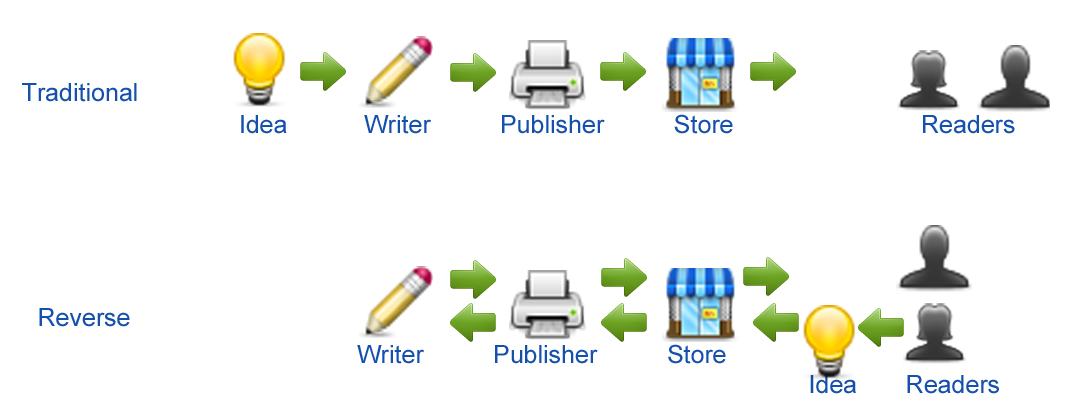
A book idea traditionally originates with a writer who finds a publisher who finds stores who ideally find readers. Basically the reverse model starts with stores who’ve found reader demand and who then find publishers who then find writers.
A model like this, which builds on what’s already out there, is not likely to be cutting-edge, but it can still produce quality books that satisfy reader demands. Depending on my mood, I vacillate between calling this the No Guts, No Glory and the Better Safe Than Sorry approach. Does this mean I have no unique book ideas to pitch of my own? Certainly not! But the struggle to get them approved is like trying to get a claustrophobic to go spelunking. It’s similar to the struggle writers under the traditional model face regularly–essentially asking a gambler to bet on you—but in this case I’m asking someone who’s risk-averse.
What this means for Acquisitions is that my “slush” pile is made of people instead of paper. Instead of looking for a good manuscript, I look for a good man or woman–a roster of writers ready and able to meet the needs of preconceived projects. With subjects ranging from crafts to sports to health, history, education, and religion, I work with a big pool of talent of not only writers but also photographers, illustrators, fact checkers, consultants, and stock photo companies –anyone who has what is needed to produce a title. The talent pool is so wide-ranging that even auctioneers and cartographers have taken a dip.
With the talent in place, my role turns back towards the conventional—developing the concept, managing budgets and schedules, negotiating rights and rates, compiling credits and copyright permission, and finally promoting the product. Based on the length of this description though, it’s understandable why I hesitate to explain.

 Trudie Gauerke
You must be logged in to post a comment.