News & Events, On Books, On Writing, Resources-Inspiration, Views

In Remembrance of Norma Fox Mazer – Part One

Do children’s book authors make good role models? They certainly make good ones up—Atticus, Katniss, Haroun, and Matilda to name a few—but what about the writers themselves? In my experience, the answer is yes.

With children’s books it seems there is a special, collaborative relationship between writer and reader. Children are not just the audience but the inspiration; their playfulness and honesty, a book’s fuel and feature. When that relationship extends off the page and writers engage with children through school visits or the web, for example, the benefits go far beyond publicity, and children go from being inspiration to being inspired themselves.

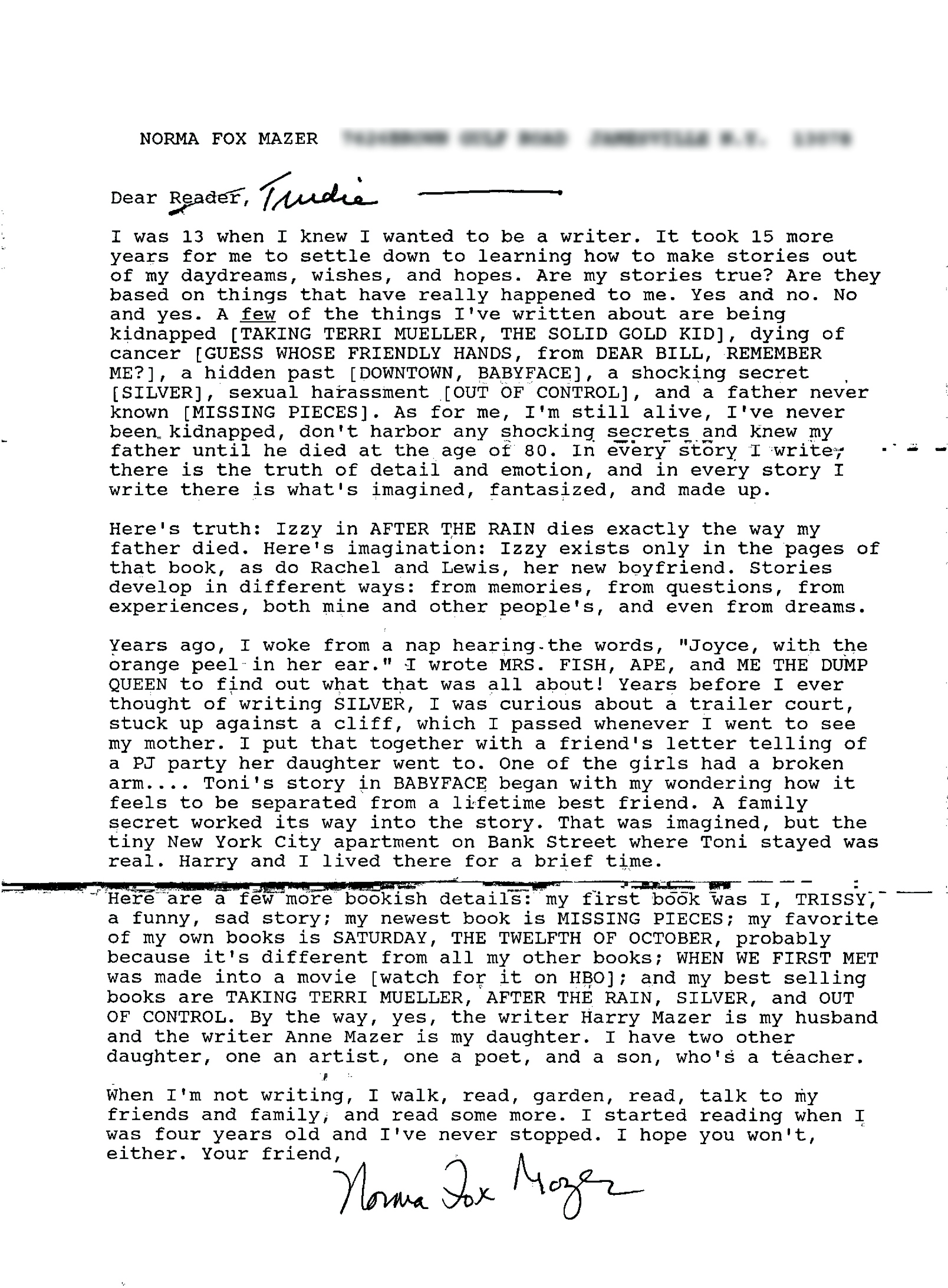
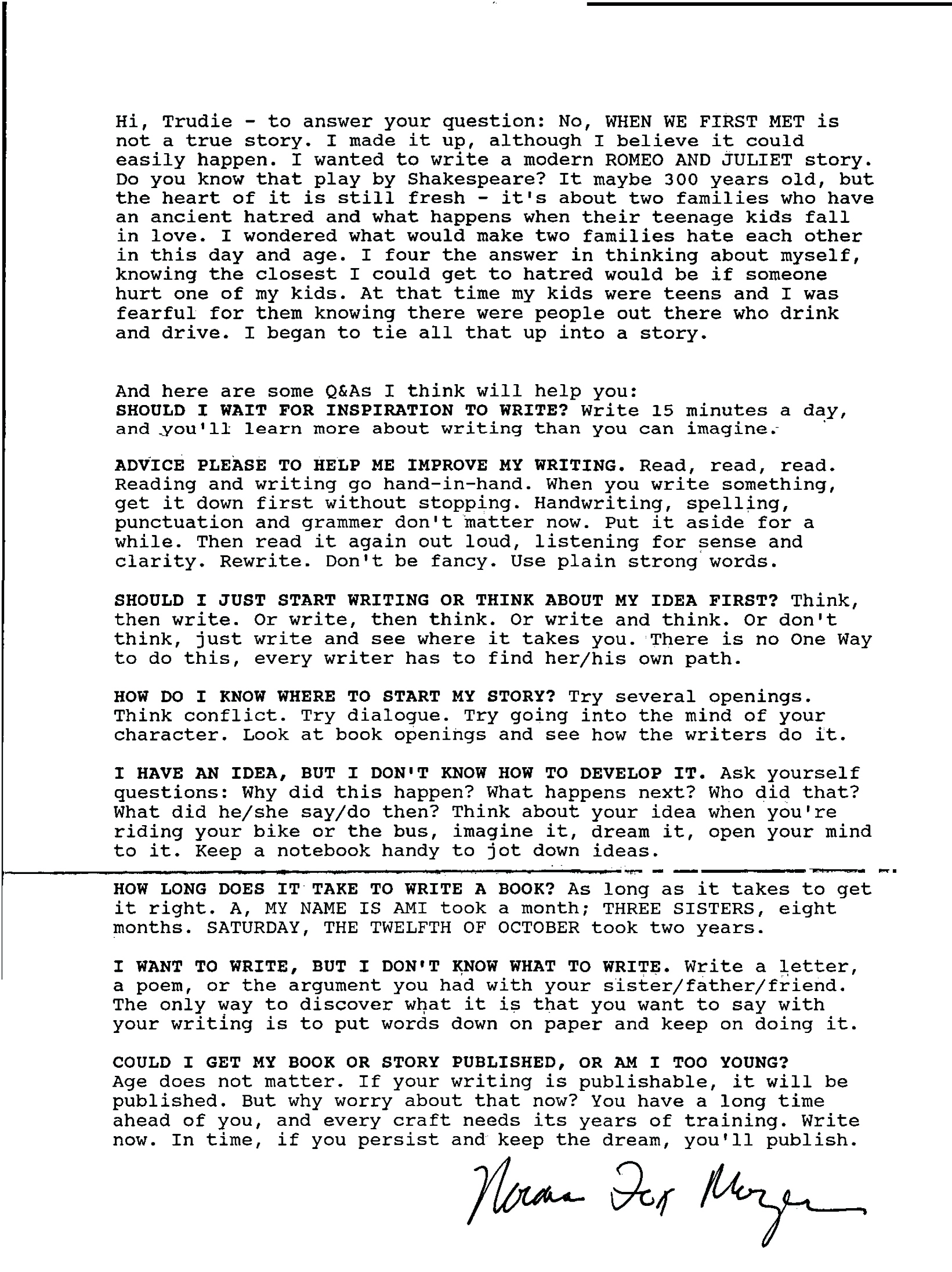
When I was young, there was no real web yet, nor email, just fan mail, and I wrote to just one person. This month marks the second anniversary of the passing of that person, the wonderful author Norma Fox Mazer. In remembrance of her, the following is her letter responding to my fan mail.
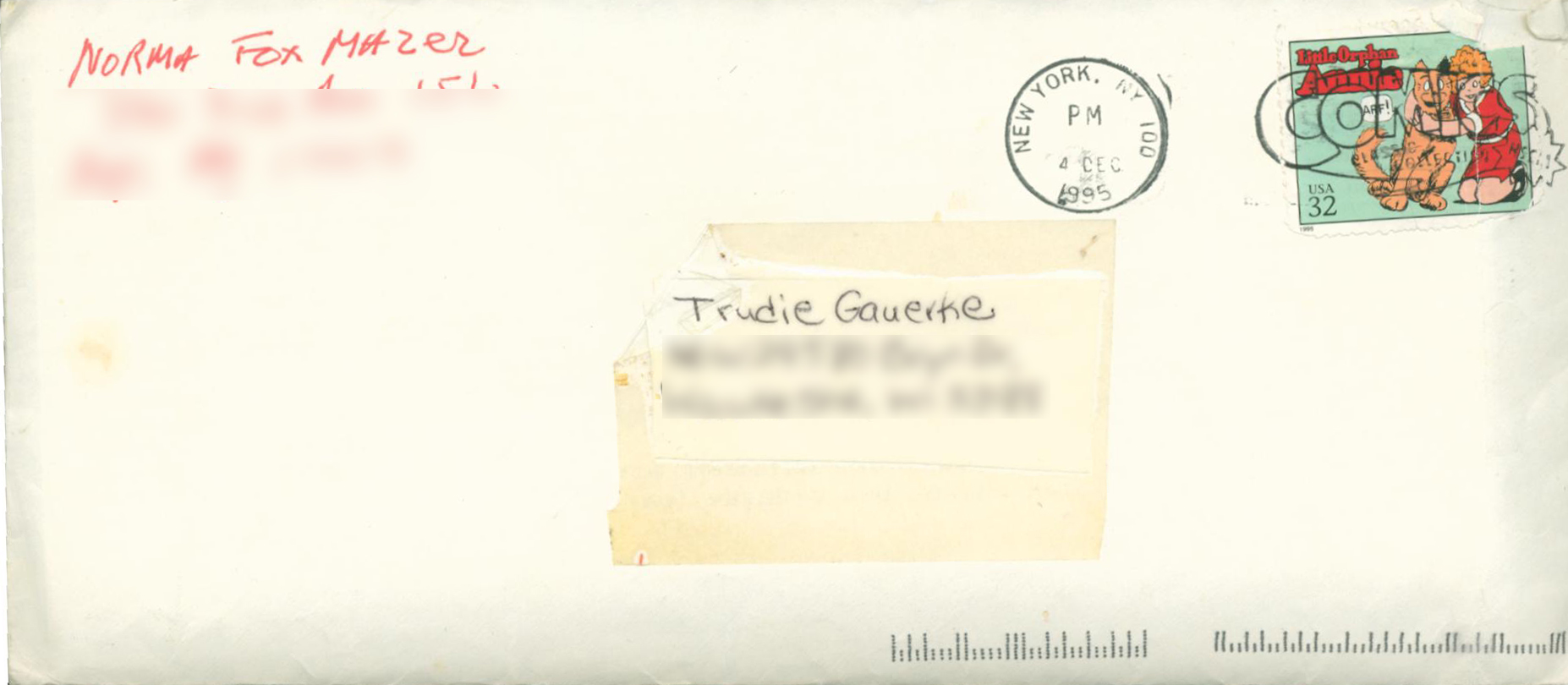
Click for pg 1
Click for pg 1
click for pg 2
click for pg 2

Though undated, the postage mark indicates the letter was sent in December of 1995 when I would have been in the eighth grade. Receiving this response had such a significant effect on me that I found myself returning to read it repeatedly for encouragement. Convinced of the importance of writers interacting with young readers, I’m delighted to see that Norma Fox Mazer’s example is carried on by one of her own children, the author Anne Mazer, who not only blogs, but regularly posts on Twitter.

Later this month, I’ll share an essay that this correspondence inspired as well as a second letter from her. In the meantime, I’m focusing on her advice to “read, read, read” and to “just write and see where it takes you.”
On Publishing, On Writing, Views

Books Without Borders

Don’t believe it when they say you need to live in New York to work in publishing.

Last year I lived in an abandoned bus in the Alaskan wilderness, enrolled at Hogwarts, and lead a barnyard coup. I saw Boo Radley and spurned the richest landed gentleman in Derbyshire. This was not merely a hobby. I was following the career advice I received from young adult author Norma Fox Mazer: “Read, read, read. Reading and writing go hand-in-hand.” Books are my passport and therapist, flooding my apartment and keeping me up past my bedtime. Jon Krakauer may have little in common with Jane Austen, but the one constant I find in books is the power of their words to incite change. My goal is simple: tap into this power and leave the world better than I found it.

Unfortunately establishing clear goals doesn’t necessarily create an open path towards accomplishment. During New York University’s Summer Publishing Institute, for example, everyone warned me that New York City was the only place to work in publishing. On behalf of my beloved Midwest, I felt a little indignant. I set out to prove them wrong, first in Milwaukee at Hal Leonard, the world’s largest publisher of songbooks and music texts and now by working in Lincolnwood for Publications International, which produces over 500 titles annually.

Although I’ve been writing since before I could form letters (when my patient mother would transcribe my story “The Monster at the End of the Book”), being published seemed an unattainable dream. Sure there were minor victories along the way: literary magazines, pitching and acquiring my first books for a publisher, even meeting the president of Costa Rica after winning a political essay contest held in his honor. Still, I couldn’t ignore the odds.

My expectations changed in April of 2006 when Publisher’s Weekly announced a new novel by A. Manette Ansay with a premise strikingly similar to one I had been plotting for years. I was beginning to think like a published writer. Perhaps it isn’t unrealistic then to expect that I can become that author instructing young fans to “read, read, read.”

I’d like the opportunity to try the roles of writer, editor, and teacher. I firmly believe that working as a writer makes a better editor and as an editor, a better writer. My participation in publishing from brainstorming to bookstore expelled that fantastical notion of the lone writer spinning gold from straw, and the fact that I was able to participate from the Midwest further dispelled the New York myth. Where else can books take me, and where would I be without them?